FIELD NOTES / KEEP IT USEFUL
How to write notes that still make sense tomorrow
A five-part note template that keeps the context, reason, example, boundaries, and next question behind an idea—not just a mysterious label.
“Do the button thing” may make perfect sense while you are having the thought. Tomorrow, it asks you to recreate the whole conversation in your head. A useful note needs enough context to stand on its own.
Try this template on one old note. It is not a requirement to write more every time. It is a way to notice which missing detail makes your notes hard to return to. The University of Reading’s note-making guide also recommends checking whether your notes will make sense later; the five-part template below is our suggested exercise.
Give the note five useful parts
Not every field needs its own heading. A short paragraph can contain all five. If a field adds nothing, leave it out rather than filling it with vague words.
Restore what the shorthand left out
The reason and boundary make the idea easier to inspect. You can now decide whether a shelf alone would do the job, instead of treating “buy a bench” as a settled plan.
Use a title you would recognize while scanning
Name the subject and a useful distinction. “A drop zone for bags by the door” tells you more than “Home idea.” “Cooking with friends, without hosting” tells you more than “Dinner.”
You do not need to guess the perfect future search phrase. Include the nouns you naturally use for the thing, plus the reason that separates this note from similar ones.
- Vague: Content idea → Clearer: Show how one pause changes a scene.
- Vague: App feature → Clearer: Capture a thought without opening the full app.
- Vague: Holiday plan → Clearer: A quiet family break with less traveling.
Keep the original when the wording matters
An edited note makes an idea easier to revisit, but the original can contain a phrase, correction, or connection that the draft missed. Keep a link to the conversation or recording when you want that context.
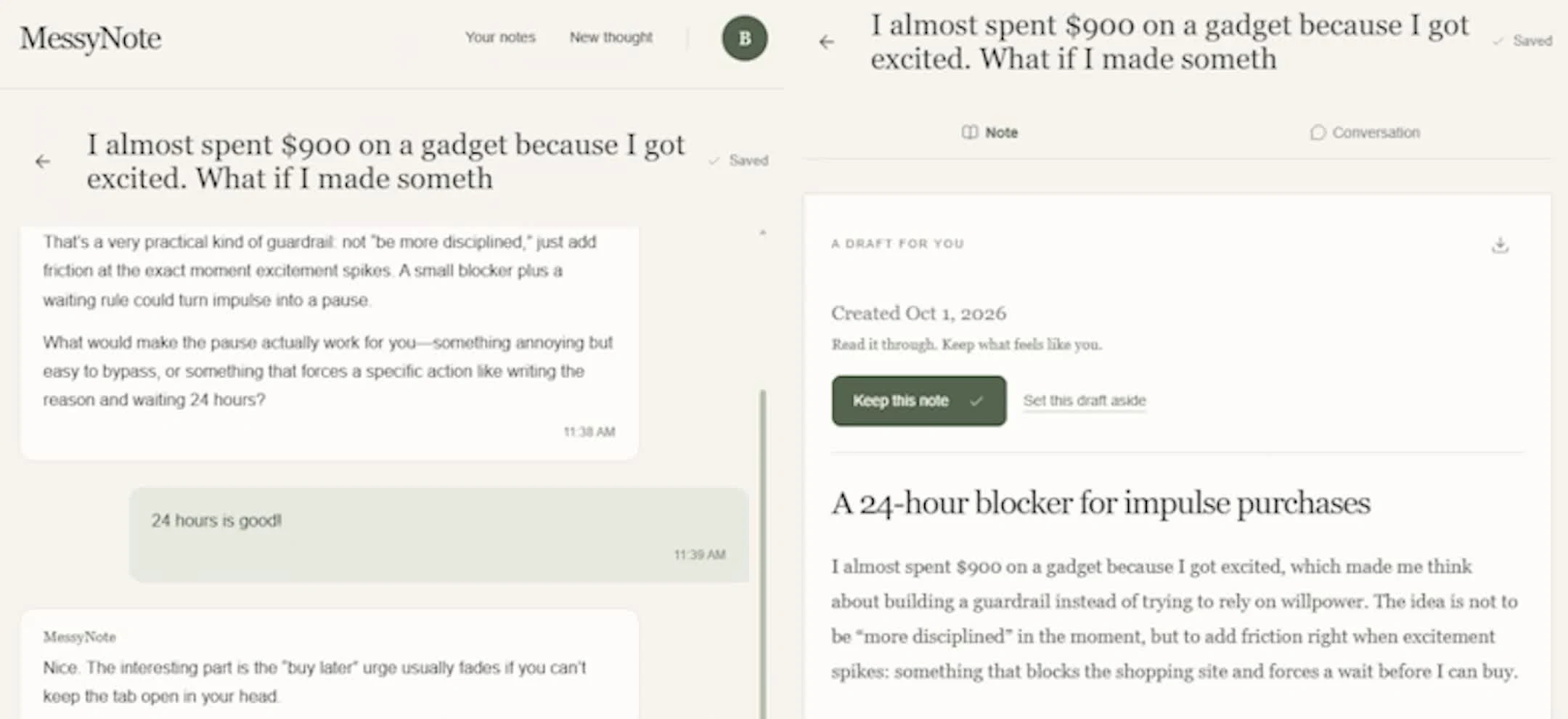
MessyNote keeps the conversation with the note. You choose when to create the draft, can edit it, and can return to the exchange that led there. Review any generated note for your actual meaning before treating it as finished.
Read it as someone who was not there
Close the original conversation and read just the note. Can you tell what interested you, which example you meant, and what remains undecided? If you cannot, add the smallest missing detail. A useful note can stay unfinished; it just needs to make the unfinished part visible.
Sources & further reading
- Effective note-making — University of Reading
Educational guidance on making notes understandable and useful later. The household scenario and five-part template here are illustrative suggestions, not research results.